Search...

Concrete batching plants come in various types, each designed to meet specific project needs, site conditions, and production requirements. Understanding the key features and applications of each type is critical to choosing the right solution for your business. Below is a detailed overview of the most common types, helping you make a targeted selection.
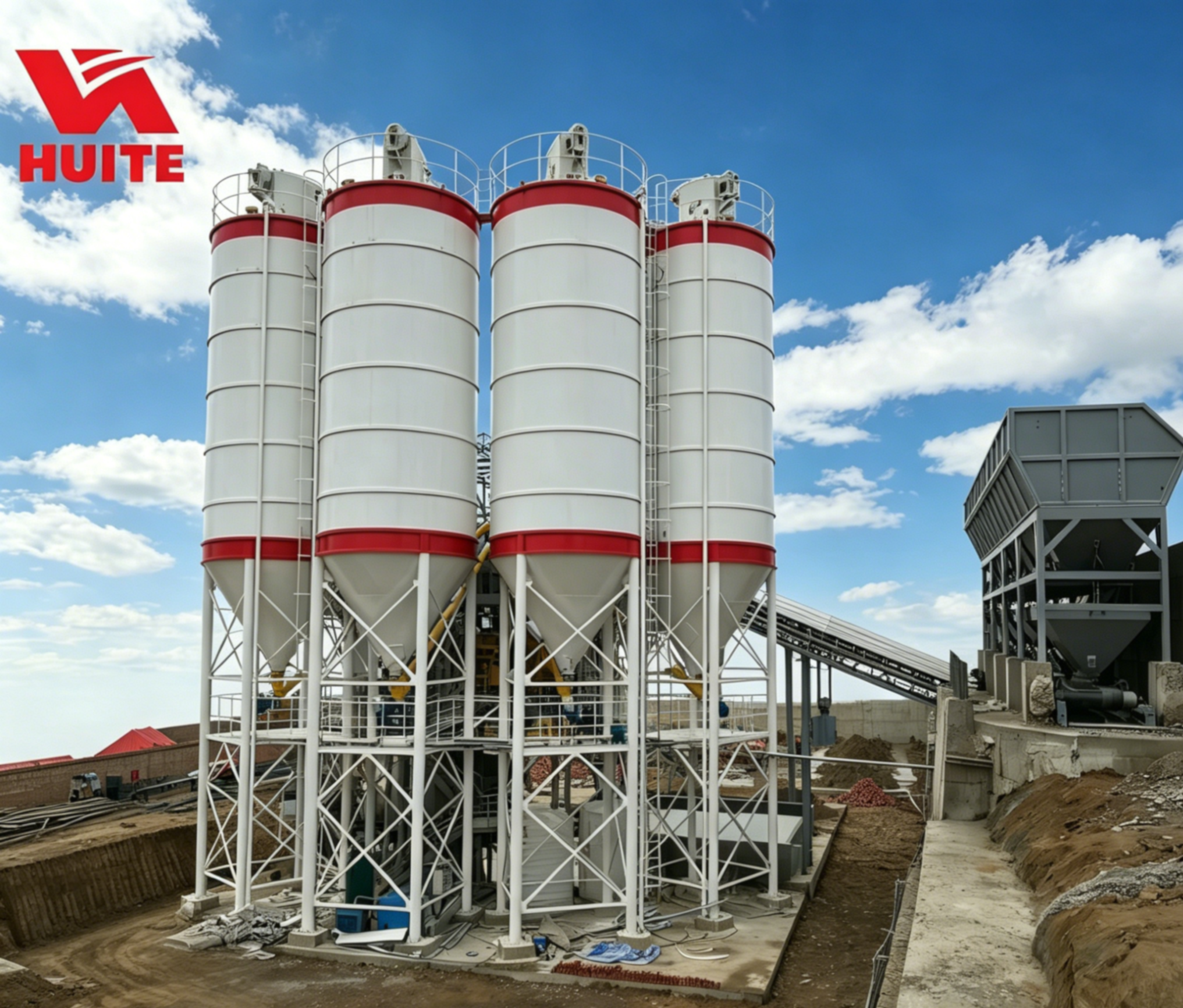
When it comes to reliable and high-performance stationary concrete batching plants, HUITE stands out as a trusted manufacturer with years of experience in the construction machinery industry. As a professional enterprise integrating R&D, production and sales, HUITE is committed to providing customized, efficient and eco-friendly concrete mixing solutions for global customers, and its stationary concrete batching plants have been widely praised in large-scale construction projects around the world for their stable performance and cost-effective advantages.
Stationary concrete batching plants are the most common type for large-scale, long-term projects. They feature a fixed design with separate components (aggregate bins, cement silos, mixers, control room) and require concrete foundations for installation. Key features include high production capacity (80–200 m³/h), stable operation, and the ability to handle multiple concrete recipes simultaneously.
HUITE’s stationary concrete batching plants, especially the HZS180 model, have upgraded these core features with advanced technology. In terms of core performance, HUITE stationary plants are equipped with high-precision measurement systems and efficient mixing hosts. The powder weighing scale adopts an octagonal design to increase the rigidity of the bucket body and prevent materials from adhering to the corners; the water and admixture measurement adopts advanced technology to ensure measurement accuracy, and the error rate can be controlled within a reasonable range, laying a solid foundation for high-quality concrete production.
They are ideal for ready-mix concrete producers, large residential developments, industrial facilities, and infrastructure projects (roads, bridges, dams) where consistent, high-volume output is required. While the initial installation time and cost are higher, stationary plants offer lower operational costs over their lifespan.
HUITE equipment adopts high-quality wear-resistant parts, simple maintenance and low operation cost; at the same time, the optimized energy-saving design reduces no-load energy consumption, and the green and environmental protection design in dust, noise and three waste treatment realizes zero pollution emission, which also reduces the environmental protection treatment cost for enterprises.
Foundation Free Concrete Batching Plants are designed for flexibility and mobility, making them perfect for short-term projects, multi-site operations, or remote areas. As the name suggests, they require no concrete foundations for installation, which significantly reduces site preparation time and costs. Mounted on trailers or skids, they allow easy transportation between job sites and can be set up in 1–3 days with minimal on-site work.
Production capacity ranges from 20–80 m³/h, suitable for small to medium-sized projects such as rural road repair, residential renovations, and emergency construction. Modern foundation free plants feature compact designs, folding components for easy transport, and pre-wired modules for quick commissioning—some models can start production in as little as 9 days under optimal conditions. They are especially popular among contractors who need to move equipment frequently or work in areas where pouring concrete foundations is impractical or cost-prohibitive.
Dry mortar plants mix dry ingredients (aggregates, cement, admixtures) at the plant, with water added only when the concrete is being transported to the job site. This type is ideal for projects where ready-mix concrete needs to be transported over long distances, as it prevents concrete setting during transport.
Dry mix plants are compact, easy to install, and suitable for remote projects with limited water access. They are commonly used in road construction, mining projects, and rural areas.
Precast plants are designed specifically for producing precast concrete components (e.g., beams, columns, slabs). They require high mixing precision and consistency, often using planetary mixers to ensure uniform concrete quality.